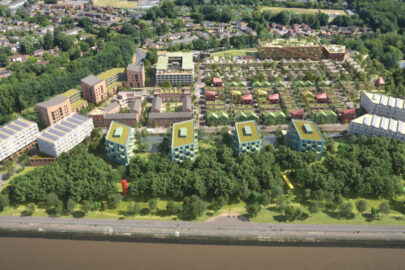
Foreign investment in Liverpool: Residential property focus
The issue of overseas investment really is a tale of two cities. National newspapers regularly report on the housing problems in the UK’s capital as wealthy foreign investors snap up residential stock causing demand to soar and house prices to follow suit.
Indeed, property investment from overseas is often said to be a major contributor to London’s housing crisis. Yet 200 miles up north here in Liverpool, it’s something that is actively welcomed and actively happening.
Words by Christine Toner

From New Chinatown’s calls for Asian investors to Peel’s continued work with Chinese backers on the development of Liverpool Waters, it seems the city is embracing overseas cash more than ever. And overseas investors, say experts, have never been so keen.
“While there are a multitude of reasons why people invest in Liverpool, four are cited most frequently by the investors we work with: the quality of the workforce and skills, quality of life, cost effectiveness and connectivity,” explains Max Steinberg, chief executive of Liverpool Vision.
“Workforce is particularly worth highlighting, as without it companies couldn’t afford to invest here no matter what other factors there may be. Our universities and colleges are at the forefront of attracting new companies and entrepreneurs to the city, and annually there are 71,000 students graduating either within the city or a one-hour drive time around it.
“As well as this, non-university education specialising in maritime and digital gives us an excellent skillset in these two growth industries.”
Max says other factors also highlight benefits to investors; for example the lower cost of property here compared to London, combined with the excellent connectivity around the UK and beyond, means it’s an attractive base for companies looking to settle in the UK.
“Quality of life and the city’s international brand can sometimes be overlooked as ‘softer’ elements, but they are absolutely crucial in distinguishing Liverpool from its competitors and making a compelling case for investors to set up here,” he adds.
> Related news: New Chinatown’s developer discusses progress
In an interview with Your Move, David Choules, chairman of New Chinatown developer North Point Global said overseas investors have shown keen interest in the scheme – particularly, as one would expect, from China and Hong Kong. He also acknowledges the lifestyle the city, and the UK, offers is a big draw.
“Through the Tier 1 entrepreneur visa programme, with each commercial space the interest is to acquire a small unit that’s affordable and although that doesn’t give a visa, by then bringing the business into Liverpool, running that business for five years and being an active part of it they can then apply for a visa,” he said.
The £200 million New Chinatown scheme will see the regeneration of the area with retail and residential developments while a hotelier is also said to be in talks to get involved.
But it’s not just new developments that are catching the eye of investors from other shores. Existing stock is also being snapped up.
“Overseas investors are looking at all development schemes throughout the city centre,” says Louis Anastasiou, chief executive officer at estate agent Andrew Louis. “Some are even looking at the second hand market and suburbs which include freehold properties.”
“We believe growth in Liverpool is steady and sustainable, rather than the ‘bubble’ that is the problem in London.”
The city’s higher education offering also plays a big part in attracting investors, in particular the huge number of foreign students attending the region’s universities.
“A number of overseas investors are purchasing apartments for their children who study at our universities,” says Louis. “So a lot of the developments will have a mix of tenants and owner occupiers.”
But Ian Taylor, lettings manager at Reeds Rains Estate & Letting Agents says while much of the overseas investment the city has received – especially from China and the Middle East – has been focused on the student market so far, that is now changing.
“As that market has become saturated, [investment] has gone into the private rental sector instead,” he says. “I think most developments that are now being built have some sort of foreign investment at some stage throughout the scheme build.”
Of course, the biggest criticism of overseas investment in our capital city is the impact it is said to be having on house prices. Is there a danger of huge increases to house prices and rent like we’re seeing in London? The experts don’t think so.
“We do not want to see a rising market of house prices in Liverpool as is happening in London,” says Liverpool City Council’s cabinet member for housing, Councillor Frank Hont. “However, London is a unique proposition – not just in the UK but on the world stage. We believe growth in Liverpool is steady and sustainable, rather than the ‘bubble’ that is the problem in London.”
Nor, say agents, is overseas investment preventing local investors from capitalising on opportunities.
“There is a fairly level playing field across the city with Liverpool-based groups, such as Elliot Group, and other UK companies building new developments and also undertaking conversions at the moment,” says Ian Taylor.
“There is nothing stopping UK investors from playing a part, they just have to be as bold as overseas investors,” adds investment specialist and founder of The Property Hub, Rob Bence. “Although the weak pound currently may give overseas investors the edge.
“Overseas investors have been investing in London for a while and see the UK as an attractive place to invest, but outside of London there are not many places they know. However, Liverpool is world famous so it provides a place where they are comfortable making investments.
“Investors are looking for alternative markets to London – both Liverpool and Manchester are really seeing the benefit of this.”
Related posts:
 Prominent Liverpool property developer receives prestigious accolade
 Residential scheme recommended for Turner Home green space
 Towers approval brings Peel’s ‘waterfront for the world’ vision closer
 Former school site to be transformed into range of homes
 Important to ensure Festival Gardens vision is ‘achievable’
 Constructing a community: Creating more than just bricks and mortar