Changing churches
Historic church buildings are positioned across Liverpool, primarily providing places of worship as well as hubs for communities. But as costly maintenance poses a challenge for church groups, conversions to residential property are proving a popular option for alternative use.
As converted church buildings and potential redevelopment opportunities are being placed on the market and listed at property auctions, Your Move takes a closer look at what it takes for a church to be decommissioned, why residential use is often the way forward and what makes the sites such an attractive proposition for property developers, tenants and buyers alike.
According to the Diocese of Liverpool, around five of the city’s Church of England churches alone have been decommissioned in the past five or six years.
It’s a decision which is by no means taken lightly, however the costly responsibilities that come with maintaining historic and listed buildings can often leave little choice.
“We’ve probably got the largest portfolio of heritage buildings in the area,” explains Stuart Haynes, director of communications for the Diocese of Liverpool. “Each church is kind of a separate organisation so there are church councils that are registered as charity trustees.
“We don’t receive any regular central funding for the upkeep – we rely on the generosity of congregations and also any grant funding that individuals can secure so it’s quite a challenge, particularly for small congregations, and sometimes we’ve got to make difficult decisions around church buildings.”
An unstable spire threatening to collapse into the roof of St John the Divine Church in Fairfield is just one example of the issues which have marred some church buildings in the city, and such problems inevitably require “substantial investment” to be repaired.
Therefore, as Stuart adds, it’s not always possible or in the best interests of the building for the church community to hold onto it.
“One of the challenges is do you try and keep a church as a building which is maybe not suitable for modern church worship and takes all of our energy, or do you let somebody else develop that building and keep and preserve the beauty of the architecture, but use it for a different purpose?” he says.
“Provided that’s done sensitively and well, that’s not necessarily a bad thing. The worst thing would be having a building rotting and decaying.”
Keeping churches in the community
So how do some church buildings come to end up as homes?
Well, for the Church of England in particular it would seem that when a congregation unfortunately does have to let go of its historic church building, selling it off to a residential property developer is far from the next step.
“We don’t just look at offloading them straight away,” insists Stuart, highlighting that finding a suitable use for a building comes before making a financial return.
For the Diocese of Liverpool, keeping the sites as part of worshipping communities, even if that means for another denomination, is the preferable way forward.
For instance, the diocese is currently said to be looking to transfer the ownership of St Paul’s Church in Stoneycroft to the Coptic Church, while some churches begin talking to other congregations and denominations themselves at earlier stages about how their site could be kept as a place of worship.
Another option is for a former church building to be taken on by the wider community, as has been the case for the Grade II*-listed Old Christ Church in Waterloo, which has been brought back in to active use by a ‘friends’ group to host community activities.
Meanwhile the Archdiocese of Liverpool has also seen a number of its former church buildings being transformed into alternative community spaces such as St Mary of the Angels Church, which was opened as Liverpool Philharmonic at the Friary in 2009 following a two-year refurbishment project to turn it into a recording and rehearsal venue.
Houses of prayer to plush pads
In the event that former church buildings are brought to the market, their potential for residential development has proven to be a catch for developers in the area.
Liverpool agent and auctioneer Sutton Kersh has dealt with a number of decommissioned churches during various stages of their transition from place of worship to residential offering, having targeted investors and developers with buildings at auction which require redevelopment, to marketing fully converted homes to prospective buyers and tenants.
At its most recent auction, the two-storey brick and stone Tetlow Church near Liverpool’s Stanley Park generated a sale for £12,500 more than its £50,000 guide price as its prospects for residential conversion were highlighted.
Meanwhile the former Stoneycroft Church on Greenfield Road in Old Swan, which was previously auctioned by Sutton Kersh, has been successfully turned into 14 apartments.
Cathy Holt, associate director at Sutton Kersh Auctions, suggests that churches’ wealth of character, original architecture and features make them popular spaces to live in and also viable investments.
“The size of rooms and the original features make them attractive to owner occupiers,” says Cathy.
“Investors achieve very good yields given the size and amount of conceivable units you can fit within the buildings.
“Churches will always hold value and increase in capital given the great original features and unique build against the conformist new build apartments and houses.”

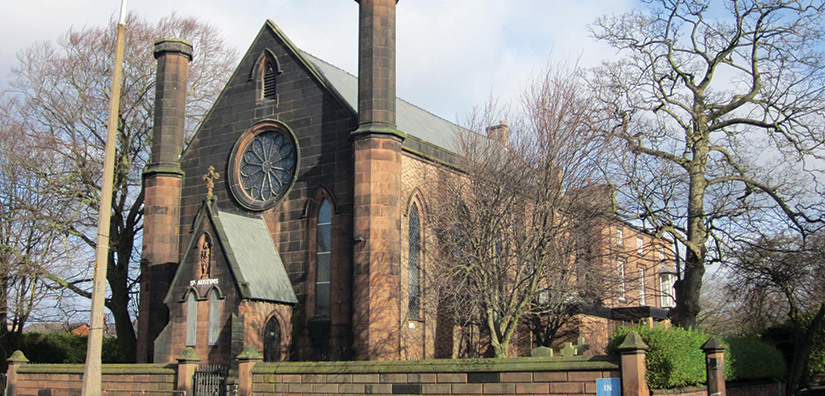
Another church seemingly on the cusp of being sold is St Austin’s Church & Presbytery on Aigburth Road which, again highlighted for its residential potential, is said to have attracted “significant demand”.
The Grade II-listed church and its rear presbytery, which were both built in 1856, were recently being marketed by Lambert Smith Hampton (LSH).
“Given its architectural merit, demonstrated by its Grade II listing and age, and combined with the established residential location, the marketing campaign which has now been brought to a conclusion has demonstrated significant demand in particular from residential developers,” says Robert Diggle, director of agency and investment at LSH.
“There are a lack of opportunities for new build residential accommodation in South Liverpool and therefore the developers take every opportunity to convert buildings when they become available, with the knowledge that there is strong occupier demand upon completion of construction.”
Further details of whether a specific buyer has been found for the site and any future plans could not be confirmed at this stage, although a deadline for bids has now passed.
“Churches will always hold value and increase in capital given the great original features and unique build against the conformist new build apartments and houses.”
For property investors and developers looking to transform former churches into homes, there’s more to think about than the church building itself.
A ‘New Uses for Former Places of Worship’ report by Historic England also highlights the importance of protecting surrounding churchyards.
“A new owner will have to take account of the need to obtain permission for any disturbance of burials, of the archaeological significance of below-ground and some upstanding churchyard structures, and of the possible wildlife and ecological significance of the churchyard,” it explains, suggesting that sufficient justification to clear historic graveyards and monuments in church grounds is “rare”.
According to the Diocese of Liverpool, sympathetic residential conversions which have taken place in the city so far have not been seen as a loss as such, but have been welcomed as they address other needs in the city.
“In an ideal world we’d have all the buildings used as worshipping communities,” says Stuart.
“Failing that then the best, most suitable use for the community is fine by us.
“If it’s providing beneficial housing to people then that’s still a need for people so that’s a good and sympathetic use and the congregation can do the church stuff elsewhere – that’s not a problem.”
Related posts:
 Buy-to-let boom: Liverpool’s thriving rental market
 Liverpool’s future: How can homes, leisure and workspace thrive alongside each other?
 Buying a home: 2017 guide to where to live in Liverpool
 Generation Rent: A testing time for tenants
 Buy-to-let in South Liverpool: Students shift to city centre
 The credit crunch 10 years on: How Liverpool’s housing market has changed