

‘Excuse me; do you know where the Lantern Theatre is?’ I asked, invading the personal space of disconcerted passers-by. It was 7.20 and the play was starting in ten minutes. They shrugged. ‘I know it’s around here somewhere’, I flailed, desperately trying to load Google Maps.
The Lantern Theatre, I discovered, is on Blundell Street in the Baltic Triangle. Tucked away at the top of a warehouse, the Lantern is unlike any other theatre in Liverpool. Run by a mother and daughter duo, the humble theatre space accompanied by a dimly lit bar, makes a pleasant change from Liverpool’s larger commercial venues.
I was on my way to watch Benefit, a touring play by Cardboard Citizens. In its own words, Cardboard Citizens ‘tells stories that need to be told.’ Set up more than 20 years ago, the company creates participatory theatre that makes positive differences to homeless and marginalised people in society.
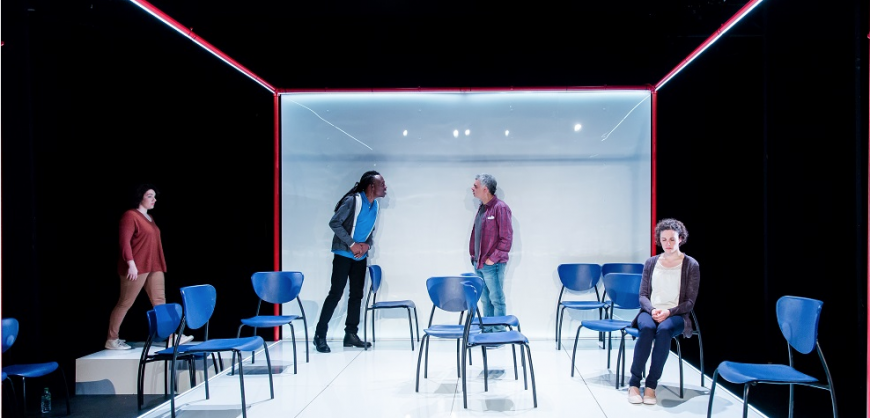
Benefit weaves the narratives of four main characters who each struggle with the social system which, for various reasons, they have come to depend on.
There’s Rosa, an English graduate, who has her Job Seekers’ Allowance sanctioned and desperately tries to keep her head above water. She is joined on stage by a couple caught in conflict as the pressure of zero hour contracts becomes too much. And finally, there’s Patrick and his crippling inability to communicate his need for welfare support.
Narratives unfold and the characters cross paths at a food bank: a space that symbolises their desperation and prompts reflection both on and off stage.
Sarah Wood’s writing is intelligent in its capacity to not only reveal the complexities of our social system but simultaneously dispel the negative stereotypes it creates.
Cardboard Citizens employs actors that have experienced homelessness at some level which makes the acting particularly hard-hitting. The set was aptly minimalist which ensured that the visceral portrayal of each character’s story remained the focus of the play.
As the lights went down, we were asked to spend the interval thinking about the events of the first act in anticipation of the second, which took on a completely different form.
Forum theatre is interactive, and encourages the audience to engage with the action on stage. With the aid of the ‘joker’ or facilitator, audience members become ‘spect-actors’ and are given the power to intervene and change the narrative.
We chose to explore Patrick’s story. Audience members (some of whom had personal experience of a similar situation) were invited on stage to take Patrick’s place and improvise an alternative course of events.
Whilst it went some way in getting to the root of the problem and exploring practical solutions, the forum aspect of Benefit didn’t go far enough. The ending bordered on forced and I was left feeling frustrated that we had only just scratched this surface. This is, however, the nature of this type of spontaneous theatre; its impact is largely dependent on the audience and quality of participation on each night.
Yet as I watched the room come to life with debate, I was reminded of the revolutionary potential of theatre. Whilst many look to the theatre for a means of escapism and entertainment, its power cannot be underestimated.
Unbeknown to most, something important was happening in a little black box at the top of a warehouse in an evolving part of Liverpool: People were using theatre to question the status quo in a space that shed light on darkness and provided a platform for voices that otherwise go unheard.
Related posts:
 Lantern to stage shows at Unity Theatre following closure
 First UK theatre with revolving auditorium planned for Liverpool’s ‘Ten Streets’
 Shakespeare North funding confirmation is ‘huge seal of approval’ for project
 Star of new Cilla Black musical has been chosen after auditions
 The Interview: Pete Best on life after The Beatles
 Half term in Liverpool – family events guide


