A duo of residential schemes in Liverpool’s Baltic Triangle will go before next week’s planning committee with a recommendation to approve.

Greenland Street scheme
The proposals, for Greenland Street and Blundell Street, have been brought forward by Davos Property Developments, a subsidiary of Liverpool-based T.J. Morris Limited as part of its regeneration programme in Liverpool city centre, and are designed by Falconer Chester Hall.
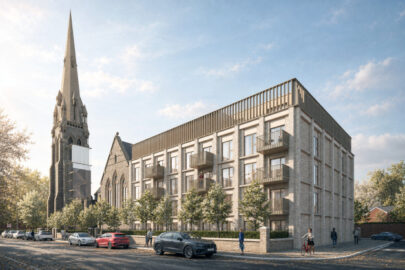
The Greenland Street project rises to 13 storeys and will include 89 one-bed homes and 110 two-bed units and townhouses, together with commercial units, a gymnasium and co-working space. It continues a positive pattern of investment along St James Street, following the Parliament Square development and the Council’s investment in its New Chinatown site.
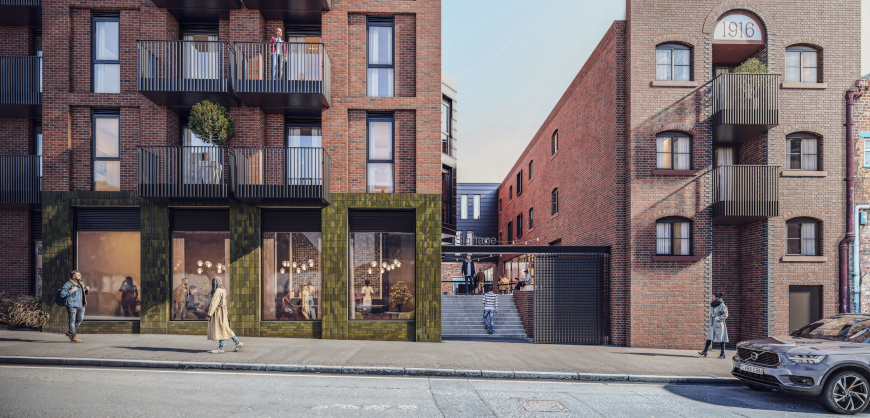
At Blundell Street (main image) permission is being sought for 59 apartments and three ground floor commercial units, with the development rising in a single step from 5 storeys at the junction with Simpson Street to 7 storeys on Blundell Street, before reducing to meet the neighbouring 3-storey warehouse, which is creatively being re-purposed into new homes. The new-build element will be joined to the warehouse by a bridge.
“Both are long-term stalled sites and despite some tricky economic headwinds our client is keen to see them play their part in the Baltic’s ongoing regeneration,” said Matt Sobic of Savills, who is advising on planning for both developments.
“The new Baltic Station will be coming online around the same time these developments, if approved, and this is a positive draw to the appeal of each site” added Matt.
Commenting on the developments’ contribution to the area’s built form, Rob Brym, project architect and associate director at Falconer Chester Hall, said: “Greenland Street offers a contemporary take on the district’s industrial architecture, whilst at Blundell Street we have taken the lovely detailing of the 1916 warehouse and reflected this in the adjoining new-build. The recessed brickwork, fenestration and balconies offer a firm nod to the street’s industrial vernacular whilst providing light and airy homes.
“Both applications have benefitted from a very constructive dialogue with Liverpool City Council’s officers, and my thanks go to them for their input. Viability has been a key issue throughout our discussions, and the council has shown great sensitivity towards this.”
The applications can be viewed on the city council’s planning portal, quoting reference numbers 25F/0791 and 25F/119. They will be heard at the planning committee meeting on 21 April.
Related posts:
 Go ahead recommended for Elan Homes’ Aigburth site
 Public consultation launched over future of Liverpool’s homes and parks
 Ion ‘committed’ to Huyton’s Earlsfield Park housing project
 Tyrers developer to help bring ‘sleeping giant’ St Helens to life after approval
 Calls for further examination and consultation on Festival Park vision
 House by Urban Splash reveals further progress at East Float development