

Written by Dave Booth
In ‘Eight Days A Week’, Ron Howard’s film about the Beatles’ dramatic arrival in America in 1964, the band talk about the sheer excitement of travelling to New York.
“We were already there in our heads,” says Ringo. “It was like this great city was drawing us in.”
Imagine then the anticipation of the Liverpool lads who’d gone before them, the young merchant seamen of the 1940s and 50s, who had left behind a war-torn land of derelict homes and rationing and were now mixing drinks for the rich and famous on board luxury passenger liners for five days or more before finally sighting one of the great skylines in the world.
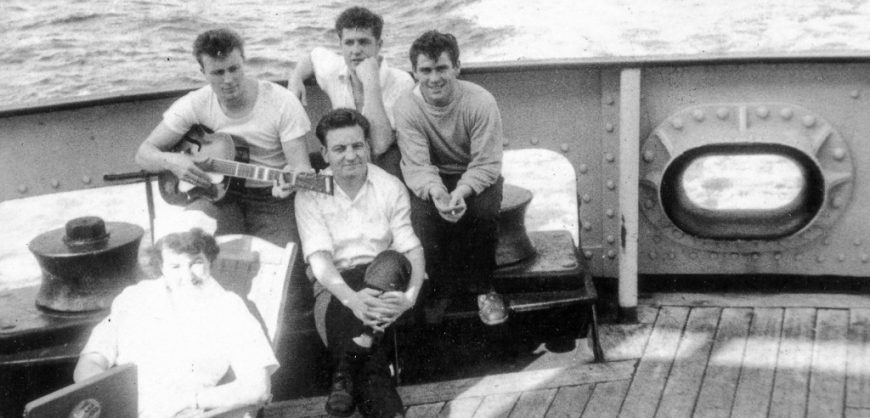
The camaraderie, adventure and excitement of that era is celebrated in a fascinating new exhibition which opens today (14 October) at The Shipping Forecast in Slater Street: Harry Stedman and the Cunard Yanks.
They would return to Liverpool with the sounds of Black America, the soul and blues, and also the country music and the early rock’n’roll that would later inspire the Merseybeat generation.
They also returned with a new look that inspired Liverpool dockers to come up with their nickname: think peacoats, chunky sweaters and button-down shirts; part Ivy League, part longshoreman. They were Cunard Yanks!
Harry now gives his name to a London-based men’s fashion brand created by his son Phil and grandson Rick (Phil’s nephew) which aims to refashion that authentic style for the 21st Century.
“The Harry Stedman look is really hard-wearing workwear,” says Rick. “It’s a premium brand but these clothes would have kept them alive: the classic peacoat, denim, Oxford button-downs and plain T-shirts. Nothing fancy, but timeless gear.
“It’s also important where we get our clothes made. As much as possible is in the UK but where we can’t it’s at places we trust such as Brookes Brothers’ original factory in the US. We have a hand-made shawl cardigan in Scotland using 2kg of merino wool and each lady who makes them will sign them. And the water they use is the same they use down the road for the local whisky!”
Billy Harrison was an 11-year-old Liverpudlian in 1947 when his dad won £5,000 on the pools and asked his son what he would like.
“I said a racing bike and a Coronet box camera,” Billy recalls.
The bike might not still be around but the camera remains in working order and was used to great effect a few years later on Billy’s seafaring adventures.
“When we went ashore it was like Dorothy in The Wizard of Oz. Liverpool felt like black and white and this was technicolour,” he adds. “We went to Radio City for the shows. It was marvellous.
“In New York I got some 35mm colour film which you couldn’t buy in Britain until 1967, and I bought a Bell and Howell 8mm movie camera for $10 from a Salvation Army shop.
“I took pictures from all over the world: Athens, Alexandria, Tangiers, Australia and New Zealand. I did it just to show my family where I’d been but it’s archive film now because it’s in colour.
“The BBC rang me up because they heard I had this colour film from the 50s and they used it in a film called Love Me Do and for the Three Queens in Liverpool programme.
“It was hard work but we saw all the big movie stars: Noel Coward, Debbie Reynolds, Burt Lancaster.
“I ended up as a chef on the original Queen Mary, which is now in Long Beach in California. I started out on deck but got talking to a chef in the Pig and Whistle, which was the bar on board, and he was on £15 a month and I was only on £7.
“So I made sure I got a kitchen porter’s job on the next trip. I knew you couldn’t wear glasses on deck so I borrowed a pair from Dolland and Aitchison on Dale Street for the interview and got the job as a KP!”
The American look also helped Billy to win over Esther, the woman who would be his wife of 57 years.
He says: “I was set up on a blind date but she wasn’t very impressed. The next time I wore a suit and this Sinatra-style hat and that did the trick.”
The ‘Harry Stedman and the Cunard Yanks’ exhibition runs at The Shipping Forecast on Slater Street in Liverpool until 27 October.
Image courtesy of Billy Harrison
Related posts:
 ‘Most in depth’ exhibition about The Jam heading to Liverpool
 First exhibition revealed for waterfront architecture gallery
 Liverpool’s exhibition on The Jam extended following demand
 Jam members to perform at fundraising finale to Liverpool display
 Exhibition begins Liverpool’s Holocaust Memorial Day events
 Review: ‘China’s First Emperor and the Terracotta Warriors’


