The Next Act
With a second album under his belt and a growing reputation as a compelling live performer, Damian Lewis is enjoying a new chapter in an already remarkable career.
The actor and musician reflects on collaborating with acclaimed producer Guy Chambers on Sweet Chaos, his lifelong love of Liverpool FC and why Band of Brothers continues to captivate audiences 25 years after its release
Words | Lawrence Saunders
Most people know you as an actor, but music has been a big part of your life for a long time. Where did that passion come from?
I’ve always played music and been in bands. In my 20s, I had a motorbike, a tent and a guitar, and spent two summers busking around France, Spain and Portugal, putting my hat down, gathering crowds and shouting at people. It was great!
I learned classical guitar as a kid, then moved on to steel-string acoustic. I had an old guitar with a broken neck, held together by the tension of the strings. I went busking with that.
There wasn’t really the opportunity to pursue music professionally. Life throws you in different directions, doesn’t it? I took the acting path and doubled down on that. I was married to a beautiful woman, Helen McCrory, who was also an actress, and we very much identified as an acting couple.
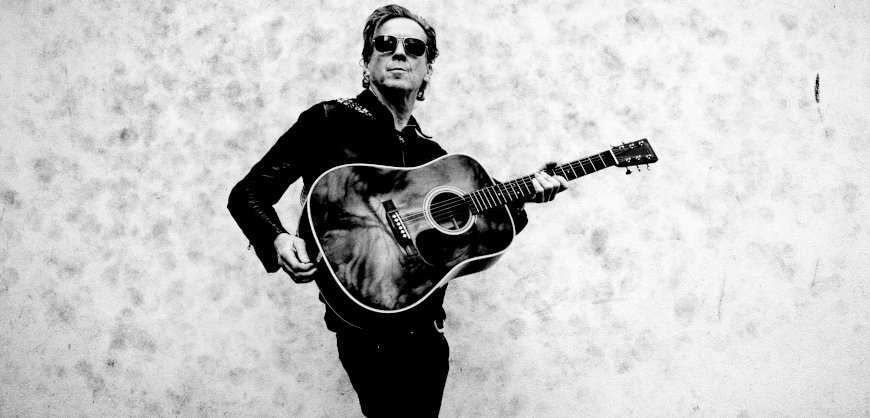
Then someone approached me about making a record and I thought, life’s too short. I’ve always played, so why not? I made an album, toured it, made a second, and now I’m touring again. I’m just doing what I’ve always done quietly in the background, only a bit more noisily!
Your debut album, Mission Creep, had quite a laid-back, rootsy sound, whereas Sweet Chaos feels more energetic, with a stronger rock influence. Was that a deliberate change in direction?
I think you’ve hit it on the head. The first record is quite tender in places. It’s rootsy singer-songwriter stuff with little bits of blues and jazz influences. I was listening to a lot of J.J. Cale and Neil Young at the time, both of whom I love, and there are actually covers of their songs on that record.
With the second album, I wanted something different. It’s more in your face, more front-foot and energised. It’s less acoustic and rootsy, more indie rock and blues rock in places.
There’s a technical difference too. We recorded the first album on tape, giving it that lovely, warm, slightly old-fashioned sound. The second was recorded digitally, so it’s more contemporary.
You worked with acclaimed songwriter and producer Guy Chambers on the new record. How did that collaboration come about?
I was introduced to Guy and he liked the songs. He offered to produce the record, which was brilliant because he’s written and produced some of the biggest pop songs ever. The man knows how to produce a tune! He’s also actually got a lot of connections to Liverpool and plenty of family and friends up there.
He was brilliant to work with and very respectful of the songs. He wasn’t full of ego and didn’t just come in and slap himself all over everything. He built the songs as he heard them and enhanced what I was trying to do. We co-wrote one song, ‘King’, and I wrote the rest [of the album]. He produced it all and understood what I wanted to achieve.
You’ve received some excellent reviews for your live performances, with one critic describing you as a “genuine musician”. Given the scepticism that sometimes surrounds actors moving into music, have you felt you’ve had to work harder to prove yourself?
Definitely. It’s a double-edged sword. You get publicity because of who you are, and you get opportunities that a lot of young bands would kill for. But at the same time, people are quietly sharpening their knives.
My attitude is that I’ve always supported people who try things. That’s the way I was brought up. Be the man in the arena, to badly quote Theodore Roosevelt. Don’t be the person standing on the sidelines sneering.
There are a lot of sneerers in the world. They’re dangerous. They’re anti-creativity, anti-fun and anti-life, and they should be ignored as much as possible because they stop people from having a go. The moment you stand up and say, ‘I’ve got something to show you’, you’re inviting opinions. That’s the blessing and curse of being an artist.
I’ve never taken on anything creative without taking it seriously. I commit 100% to every acting role and approach music the same way. It’s what I teach my kids. You only get out what you put in. If you put nothing in, you’ll pull nothing out.
One of the more personal tracks on Sweet Chaos is ‘Pentonville Prison’, which tells the story of a serious motorcycle accident you had in 1998. What made you revisit that experience all these years later?
I just thought it was a cool story! The way my memory works, sometimes things don’t come back to me for years. Something happens, gets lost in the hubbub of life, and then years later you find yourself thinking about it again.
It’s about a motorbike crash outside Pentonville Prison, I should say, not my time inside! It was serious. My head went halfway through a car windscreen and shattered the glass.
It was dark and raining slightly. I saw a car waiting to turn, then just as I got there, the driver pulled out. He obviously hadn’t seen me. I was knocked unconscious and woke up about 15 minutes later, lying in the recovery position in the middle of the road. I still had my helmet on and someone was holding my wrist really tightly.
It was an off-duty nurse who’d been drinking at a party and got a taxi home. He’d jumped out to help me. I called him a couple of weeks later to thank him. I asked why he’d been gripping my wrist so tightly, because it had frightened me. He said: ‘Mate, I couldn’t tell if you were dead or if I was too pissed
to feel your pulse!’
I was very lucky. My jaw was badly swollen and I had a bruise the size of a tennis ball. But thank God I’d been wearing a full-face helmet that night. I often used to wear an open-face one. If I’d been wearing that, I wouldn’t have had a face left.
You’re a lifelong Liverpool FC supporter, but you’ve also got a family connection to the city, haven’t you?
I’m half Welsh, and my grandmother – my nain – was a Welsh speaker. Her family lived in Liverpool for a while and she was an Everton supporter! That was my early connection with Liverpool.
But unfortunately for the Blues, they just couldn’t compete with Liverpool in the late 1970s and early 1980s. All my favourite players were Liverpool players, and that’s how I ended up supporting a team 350 miles away from where I live, which is really inconvenient! But they’re my boys. You can’t change that. I love being in Liverpool and I always look forward to coming back.
You followed the club to the Champions League finals in Kyiv and Paris. What are your memories of those occasions?
Paris was awful. I remember a lad, of about 12, rushing towards the turnstiles with his eyes streaming because he’d been sprayed on the way in. He was just a kid.
But there was a slightly comical ending to that weekend. Liverpool kindly offered me a seat on a chartered plane with some staff. I sat next to John Bishop and we were saying, ‘Aren’t we lucky? Isn’t life great?’ Then we sat on the tarmac for seven or eight hours, watching all the scheduled flights taking off!
It was quite a ridiculous ending to what had already been a really awful weekend.
It’s now 25 years since Band of Brothers first aired, and it remains one of the most highly regarded television series ever made. Why do you think it continues to resonate with audiences?
I think the first obvious thing to say is that if something’s brilliant, it survives. Some things are brilliant for their time but become dated. Band of Brothers was shot with documentary-style camera work that never gets old because we see that sort of footage on the news every day. It feels incredibly real.
And there was something in the water at HBO at that time. You had Band of Brothers, The Sopranos and then The Wire. Those three shows transformed television. Suddenly television was this big, epic, painstakingly made drama with filmmakers, great writers and actors. It changed everything.
But I think what Band of Brothers shows so brilliantly is ordinary lads doing extraordinary things. They were losing their best mates, living in foxholes, enduring the most appalling conditions, and so many of them were only 19 or 20 years old.
I met the real veterans of Easy Company and heard their stories. Sadly, they’ve all passed away now. For many of them, the first time they’d ever been in an aeroplane was to jump out of one. They’d tell these wonderful stories about taking their families on a flight years after the war, and how frightened they were when the plane came in to land because they’d never actually landed in one before! These were remarkable people.
It must have been an enormous responsibility portraying Major Richard Winters, particularly with the real veterans involved in the production.
There was no more serious job in my entire career than Band of Brothers. We were looking these 80-year-old men in the face. They’d endured a year of combat with little relief from the front line, helped liberate Europe and reached Hitler’s Eagle’s Nest.
You just wanted to get it right. Every fibre of your body wanted to represent them in the best possible way. And that bonded all of us actors in an incredible way. We developed this wonderful fraternity and we’re still great friends today. It’s a friendship that was passed on to us as a result of representing the extraordinary feats of these remarkable young men.
Do you have a favourite memory from filming Band of Brothers?
We had one of those terrible British summers, freezing for almost the entire shoot. We had about two days of sunshine and the moment the sun came out, all the British lads stripped off, as we do! Everyone was running around in shorts, tops off, and came in the next day looking like lobsters. The Americans were thinking, ‘What the hell is going on? Why is everybody naked?’ They still thought it was quite cold!
We used to play American football as well, shirts versus skins. We were rubbish at it, but we had our kit off and didn’t care. We were like Celtic warriors! There were lots of good memories like that.