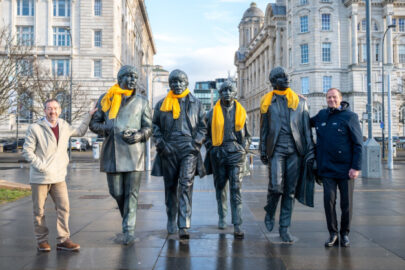
Not For Sayle
From growing up in a communist household a stone’s throw from Anfield to a career spanning stand-up, TV, film and political activism, Alexei Sayle has rarely followed a conventional path.
As he releases his latest memoir, How I’ve Tried to Change the World By Walking Down the Middle of the Street Shouting, Alexei reflects on a lifetime of protest and explains why becoming an unlikely ‘national treasure’ hasn’t blunted his bite.
Words | Lawrence Saunders
This is your third memoir, following Stalin Ate My Homework and Thatcher Stole My Trousers. What made you want to write another one now, and how did you decide what story you wanted it to tell?
Having written two volumes, I wanted to do a third, but my life after the mid-’80s was one of relative success really, and there’s no tension there. It was only when I thought about my life on the left that I realised there was a story with a lot of tension, a lot of defeat, a lot of struggle and a lot of battling.
[So the new book] wouldn’t just be a litany of TV shows and meetings and movies. It would be about this lifelong struggle that I’ve been involved in, which has really been mostly about defeats rather than successes. Also, my editor at Orion Publishing felt that a book about the left, written by somebody who’s been on the left their whole life, was right for this time.
There’s a massive demand amongst people just to know what left ideas are, and for a justification of them, because often left ideas – particularly pro-Palestinian – are made illegal. Support for Palestine, direct action for Palestine, has been equated with terrorism by the British state. I think people know that’s all a lie, really. And the idea of marches being ‘hate marches’ – I think a lot of people intuitively think that’s untrue. But they don’t quite know what the truth is, and so they’re looking for guidance, I guess.
At the start of the book, you compare Keir Starmer to Mussolini. Are you any more enamoured with his replacement?
I’m cautiously pessimistic about Andy Burnham. Lenin – a somewhat problematic individual [laughs] – sort of said that the purpose of the Labour Party is to delude the British working class. I think Burnham will carry on that tradition.
One of the things that is horrific but useful about the Palestinian struggle is that it’s an amazing way to gauge who somebody is in their essence. If they support the Palestinian struggle, then they are honest. If they cave in to the Israel lobby, then they’ll cave on other things too. I’m sorry it has to be this way, but I think it’s a really useful way of judging somebody.
So if Burnham does something concrete – if he rescinds, for instance, the framing of Palestine Action as a terrorist organisation; if he commutes the sentences of those poor kids who have received six or seven-year sentences, longer than they might get for manslaughter, in really harsh conditions; if he rolls back on jury trials and on sending arms to Israel – if he takes some concrete action rather than just words, then I would think more kindly of him.
Andy Burnham is famously a big Everton fan. You grew up on Valley Road, very close to Anfield, but you’ve said you never chose between Liverpool and Everton. How did you avoid gravitating towards Liverpool, living so close to the ground?
It was weird, really, because it was an ordinary working-class suburb that would be transformed every fortnight into this kind of ‘backstage at the circus’. Living so close to [Anfield], I felt like we were part of the club, in some ill-defined way.
It’s partly a joke, but the team we really supported in our house was Moscow Dynamo – and, you know, wearing a Moscow Dynamo kit to school on a Monday morning would have been somewhat problematic [laughs].
My dad used to take me when I was a kid and we’d alternate between Liverpool and Everton. But there was also this idea that, if it wasn’t for football, the workers would be studying dialectical and historical materialism. And there is something in that, in a way – particularly now. Bread and circuses and all that. The way dying empires distract from what’s going on through spectacle.
So I’ve always had this weird, ambiguous relationship with football. I know a lot about it and I follow it. I think it’s important to do that. But I’ve never been able to get behind any particular team.
Does it strike you now just how unusual your childhood was? Or did going on marches and growing up in that political environment simply feel normal at the time?
Oh no, I think I always knew [laughs]. You couldn’t really think that what I was doing was normal. You were aware that it was outside the mainstream, and we celebrated that. My parents always embraced it and thought our communism was one of the things that made us special.
It’s like being in any cult, in a way – you think you know the secret of how the world works.

© Roberto Ricciuti Photographer
In the book, you mention a photograph of your mother at a demonstration in Liverpool, saying she looked as happy as you’d ever seen her. Did you ever share that same sense of enjoyment when you were marching?
No, not really. I’ve always had a much more ambiguous relationship with marching, even today. I’ve been on more or less every Gaza march there’s been, and I’m proud to be in that crowd. But on the other hand, we’re not being listened to – or we’re only very slowly being listened to. So there’s the rage and the impotence and the anger. It’s a very complicated emotion, I think, for me anyway.
But also, to me, those marches represent the best of Britain – middle-class people, Muslim kids from the East End and places like Luton, and lots of Jews. It’s amazing.
You say you’re not being listened to, so what keeps you going back to the marches?
When faced with genocide, what else are you going to do, really, apart from protest? Also, it’s not difficult for me because it’s what my work’s about, and I think I’m in a position where it’s unlikely that I will be sanctioned or penalised for saying these things, which is not necessarily true of younger performers. Given that it’s easy for me to speak out, relatively cost-free, why wouldn’t I?
Reading the book, I was struck by the sense that, despite all the defeats, you still seem to have some optimism. Is that fair?
I think there are hopeful signs, particularly in the United States, in the way people are turning away from the establishment Democratic Party. I think that’s very hopeful, and similarly [here in the UK] with the Greens. It’s not going to be an easy ride for them, but there are some grounds for hope.
Also, despite all the propaganda to the contrary, people have an intuitive sense that the solutions to humanity’s problems undeniably lie somewhere on what you call the left. Somewhere within left-wing ideas lie the solutions to the climate emergency and the rise of autocracies. The solutions don’t lie with Michael Gove, or within the right wing. It’s a neck-and-neck race, in a way, between the forces of darkness and the forces of light. They pull ahead, we pull ahead. I think there is cause for optimism.
Indiana Jones and the Last Crusade – or, as you call it, Indiana Jones and the Sultan of Hatay – also gets a mention in the book. How did your role as the Sultan come about, and what was it like being part of such a big Hollywood production?
[Steven] Spielberg just asked me to be in it. The production was mainly based in the UK, so a lot of the lesser roles went to UK actors. It was 1988, and I was hot at the time, as it were. I don’t know what [Spielberg’s] thinking was. He said, ‘Do you wanna do this?’ and I said, ‘Yeah, all right’.
Where we filmed my scene, in Almería, Spain, I’d done a terrible sci-fi movie a couple of years before called Solarbabies. So we stayed in the same hotel and filmed in similar locations up in the mountains. I was familiar with the place and knew some of the people where we were staying. That’s got nothing to do with the film [laughs].
Movies are weird in some ways because it doesn’t matter how big they are, whether it’s a Hollywood movie or a small independent thing, you’re always kind of standing in a field in somebody else’s clothes. You’ve got no money, and you can’t go and get a coffee or anything because you’re dressed as a pirate and you’re 50 miles away from civilisation.
So movies are always uncomfortable in that way. It’s just something people never see if they don’t work on them. One of the things actors do is disguise that. It was a big Hollywood movie, but it was also just standing somewhere in a stupid outfit. The role didn’t require a lot of acting. I was just me, doing my stuff.
You’re coming back to Liverpool in November to talk about the book at a special event in Cains Brewery Village. Do you get back to the city very often?
We’ve got family up near Ormskirk way, so we get back a bit. I try to. I was on Valley Road the other week for an article in The Guardian, and it made me realise that the previous time I’d been back to our old house was to do a little film for The One Show.
I’d also been back to make a film for The One Show about Homebaked Bakery, and another at the Metropolitan Cathedral. So most of the times I’ve been back to Liverpool have been to make films for The One Show [laughs]. It’s been my primary motive for coming back. But yeah, I try to get back whenever I can.
You’ve been described as someone approaching ‘national treasure’ status. Do you find that amusing, given that you’ve spent so much of your life railing against the establishment?
I don’t mind, really, because it’s not as if I’ve diluted any of my beliefs. It’s kind of funny to me that I could have that status while remaining an unrepentant Marxist. I suppose ‘national treasure’ implies a kind of lack of bite.

So does that mean we’ll be seeing you on the next series of Strictly Come Dancing?
No, no, no. I f ***ing hate that. It’s awful in so many different ways.
How I’ve Tried to Change the World: By Walking Down the Middle of the Street Shouting, is available now. Alexei will appear live at Content in Cains Brewery Village on 9 November, discussing the book in conversation with Frank Cottrell-Boyce.
Main Image © Gary Doak Photography
Related posts:
 Lauren McQueen interview: Liverpool actress on her career so far & role in ‘Band of Brothers’ follow-up ‘Masters of the Air’
 BBC announces casting for new Liverpool crime drama ‘This City Is Ours’
 James Nelson-Joyce interview: Liverpool actor on reaching the ‘next level’ with major new roles
 Strictly champion Chris McCausland on his new autobiography ‘Keep Laughing’
 The Slaughter House pub reopens its doors
 Barry Sloane on chasing his dreams and returning home for new BBC crime drama