Review: Don McCullin exhibition at Tate Liverpool
A major retrospective of the legendary British photographer is currently on display at Tate Liverpool. Tom Beattie went along to find out more.

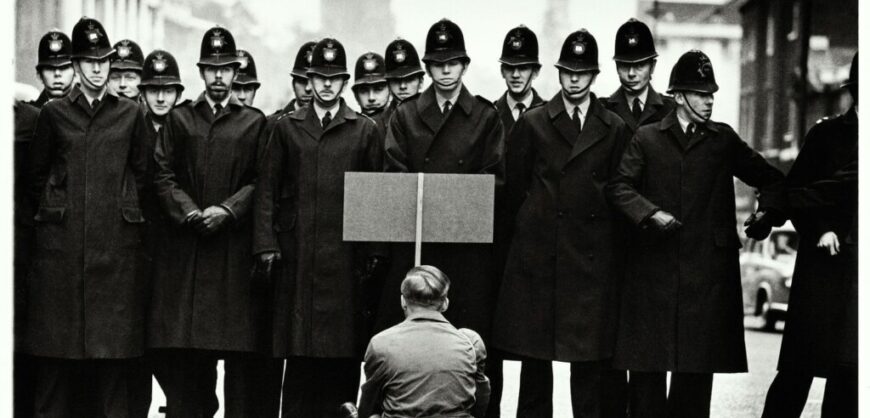
Liverpool 8 Neighbourhood, Liverpool circa 1970 © Don McCullin. Main image: Protester, Cuban Missile Crisis, Whitehall, London 1962 © Don McCullin
IT IS IMPOSSIBLE NOT TO BE LEFT AWESTRUCK by the works of war photographer, Don McCullin. His life as a photojournalist, told impactfully by Tate Liverpool’s most recent exhibition, is just as fascinating as it is important. So often, as the old adage goes, a picture paints a thousand words and in the case of McCullin, it is accurate to suggest that his depictions have helped shape the narratives of history.
The exhibition, which runs until 9 May 2021, displays over 200 images from McCullin’s beginnings in 1958, documenting his surroundings and local community in his native Finsbury Park in London, to his timeless capturing of numerous defining conflicts of the 20th Century including Vietnam, Northern Ireland, Lebanon and Biafra working for the Observer and, later, The Sunday Times.
The retrospective, spanning 60 years, includes many of McCullin’s most iconic and poignant photographs including Shell-shocked US Marine, The Battle of Hue 1968 and Starving Twenty Four Year Old Mother with Child, Biafra 1968, alongside the photographer’s own hand-printed silver gelatin prints, helmet and the Nikon camera that took a bullet for him in Cambodia.
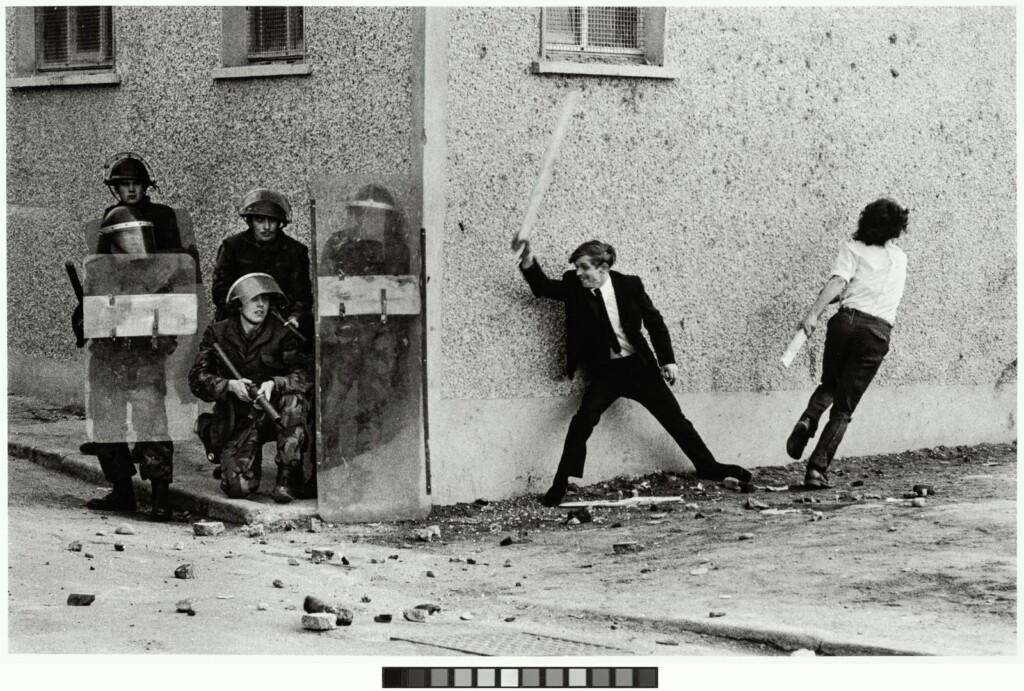
Catholic Youths Attacking British Soldiers in the Bogside of Derry-Londonderry 1971 © Don McCullin
In this wide-ranging career retrospective, it becomes clear that McCullin’s overriding passion was for recording the devastating ways in which war, politics and poverty affected the lives of those caught up in the struggle. Undoubtedly, our understanding of the 20th century, from the perspective of working-class people, would be lesser had it not been for McCullin’s moving, empathetic brand of photography. In this rare but essential quality, which is a permanent feature of his work, lies its inalienable excellence and significance.
The images of conflict are harrowing; they capture pure and visceral emotion. They display, rather than McCullin being a detached, voyeuristic fly-on-the-wall, a man who was willing to bear his own soul and emotion through his photography. So often, McCullin’s work portrays chilling, anguish-filled scenes that are impossible to overlook.
They grip you almost by the collar and compel you to stand to attention. After all, this is the power of the best journalism; the best photography. It has the ability to change perspectives, provide a voice to the voiceless and, most importantly, can change lives.
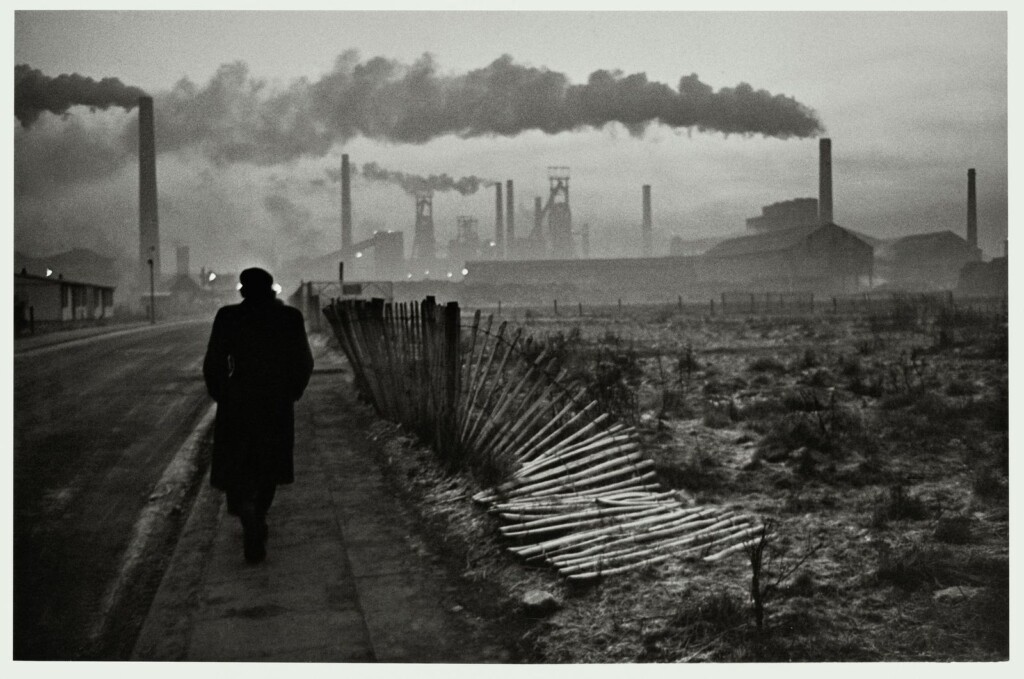
Early shift, West Hartlepool steelworks, County Durham 1963 © Don McCullin
The poignancy of McCullin’s work will make the retrospective an emotionally charged experience for many, however, there is no doubt that the unforgettable nature of the touching and affecting moments he was able to capture now represent the encapsulation of real-time moments in history.
The theme would continue upon his return to Britain, where McCullin felt compelled to publicly highlight areas of the country that had been largely overlooked and unseen by the British middle-classes.
Having been born into a working-class family in London, McCullin identified with the most deprived areas of the north of England and, in some never before seen pictures that have been personally developed by the legendary photographer for this exhibition, we see scenes from Bradford and Liverpool in the 1960s and 70s, two cities that were suffering widespread poverty as a result of de-industrialisation.
He saw his role as a commitment to ‘reporting back’ and, over 40 years since some of the shots were taken, it becomes clear that McCullin’s work has now assumed as pivotal a role in recording 20th century urban history, as it once had at recording the present. The dark, post-industrial scenes will be easily recalled by some, however, to younger viewers, it is not an overstatement to suggest that they will portray an era that almost will feel otherworldly.
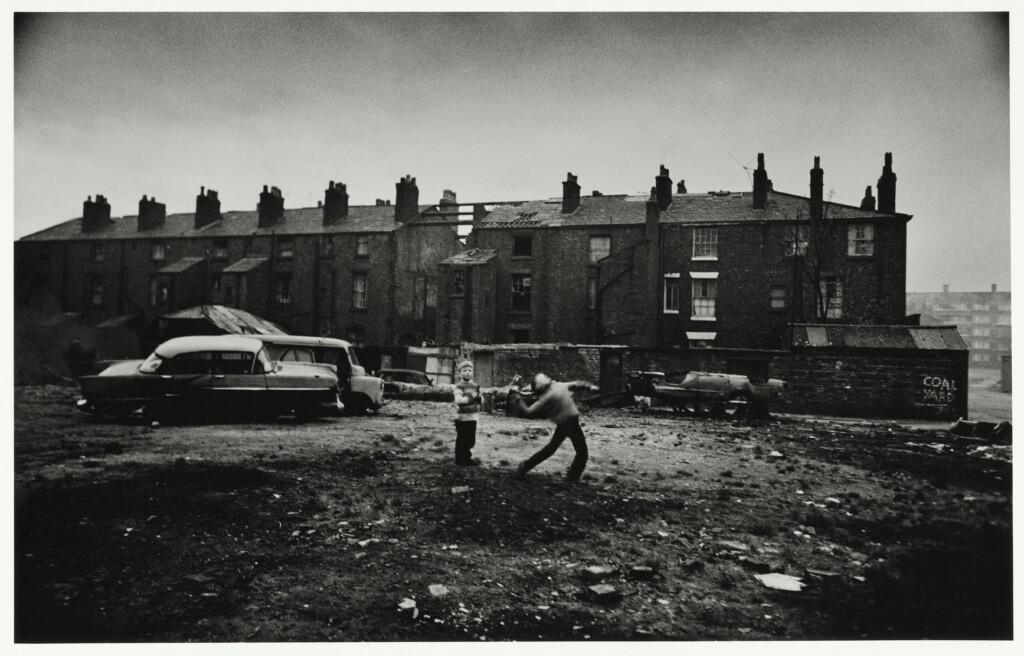
Liverpool 8 1961 Tate Purchased 2012 © Don McCullin
In a city that, to this day, suffers from poverty on a devastating scale, many will ponder how much has really changed. Perhaps this is the greatest power of McCullin’s photography.
Not only does it make us face the realities of our past, but most remarkably, it compels us to address the fact that as dramatic and provocative as his work undoubtedly will be for those who are viewing it for a first time, the same problems that McCullin so masterfully reflected are still very much apparent in our communities.
This exhibition is a must-see; it invites as many questions about our past as it does about our present.
Don McCullin is at Tate Liverpool until May 9 2021
Related posts:
 Review: ‘Tracey Emin and William Blake in Focus’, Tate Liverpool
 Review: Tate Liverpool unveils double summer exhibition
 Review – Francis Bacon: Invisible Rooms at Tate Liverpool
 Tracey Emin – ‘My Bed’ at Tate Liverpool: Curator discusses exhibition
 Tate Liverpool summer exhibition explores Germany’s past
 Gallery: Andrew Marr unveils Liverpool art exhibition