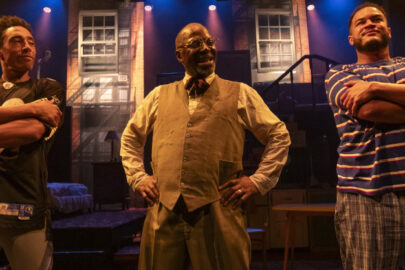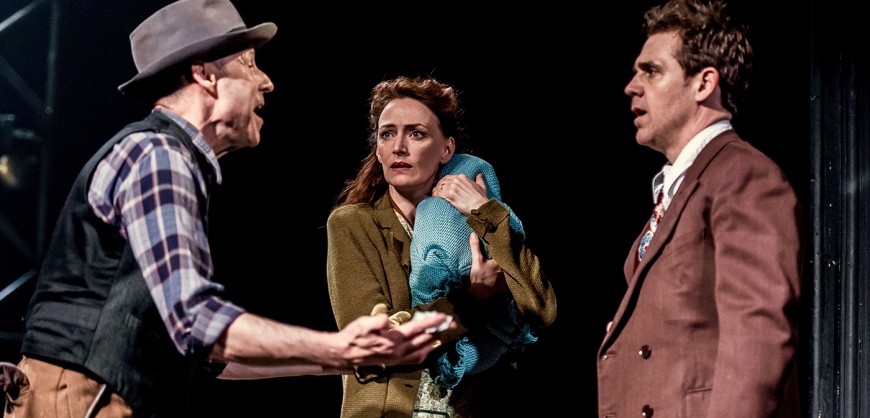
To celebrate 100 years since Arthur Miller’s birth, the Liverpool Everyman is playing host to the world premiere of The Hook.
Written in the 1950s, at a time when communist paranoia was sweeping across America and McCarthyism was at its peak, it’s easy to see why this lesser known work – originally written as a screenplay – never saw the light of day.
Now more than 60 years later the subversive script, adapted by Ron Hutchinson, has been unearthed for Liverpool audiences.
Set in the docks of New York, The Hook centres on protagonist Marty Ferrara, a longshoreman, who challenges the corruption of his trade: a ship steered by power-hungry racketeers set on stripping away the workers’ rights.
In a bid to give back the power to the people, Marty runs for presidency of the union. As the story unfolds, we see a man torn between providing a stable life for his family and standing up for justice.
In many ways, Miller writes the perfect protagonist; he finds a balance between building a character that is at times frustrating to watch, but whose dedication to his fellow men makes him worthy of empathy.
James Sives does a fantastic job in his depiction of Marty and, together with his on-stage wife – performed with pathos by Susie Trayling- the pair evoke a warm response.
Despite a few questionable Bronx accents, the cast was strong and the support of a community ensemble helped build a sense of comradeship.
The set aptly takes the form of a ship – its creaks and sighs a recurring theme in the soundtrack – yet the upper decking doubles up as the Ferrara’s family home. Indeed, some of the play’s most beautiful scenes are created as we peer through the window and watch Marty’s private life play out in silence.
After an enthralling first act, the energy of the second builds quickly as the votes for the presidency are cast and counted. In a clever plot twist, we find that despite the votes being fixed to guarantee Marty’s failure, even when they are recounted he fails to gain a majority – the workers did not vote him in.
And, frankly, it’s disappointing. Why? Because we’re on Marty’s side; we want him to make a change and we want the men to support him. But instead, we are left with an anti-climax: a realistic ending where both sides meet in the middle and compromise. And whilst it may well be the most honest of endings, I couldn’t help but feel a little disheartened; after all the talk of revolution, few men were willing to rock the boat.
As I left the auditorium, it wasn’t the play itself which gave me food for thought, but how it resonates with our city’s heritage. To mark the production’s collaboration with The Casa – a charitable trust born out of the Liverpool Dockers’ dispute of the mid 1990s – the walls of the foyer have been draped with the union flags of the time. It is by no coincidence that, as the programme of events celebrating the Cunard’s 175th transatlantic anniversary draws to a close, the Everyman theatre is embarking on a voyage of solidarity with the Dockers of Liverpool’s past.
Related posts:
 Joseph and the Amazing Technicolor Dreamcoat at the Liverpool Empire review
 Aladdin at Liverpool Empire review
 Theatre fans to get a behind the scenes look at Everyman Company
 Royal Court to receive annual Arts Council England funding through new status
 Teatro Pomodoro interview: The award-winning Liverpool-based performance group
 Call for budding Liverpool performers to apply for free training scheme