

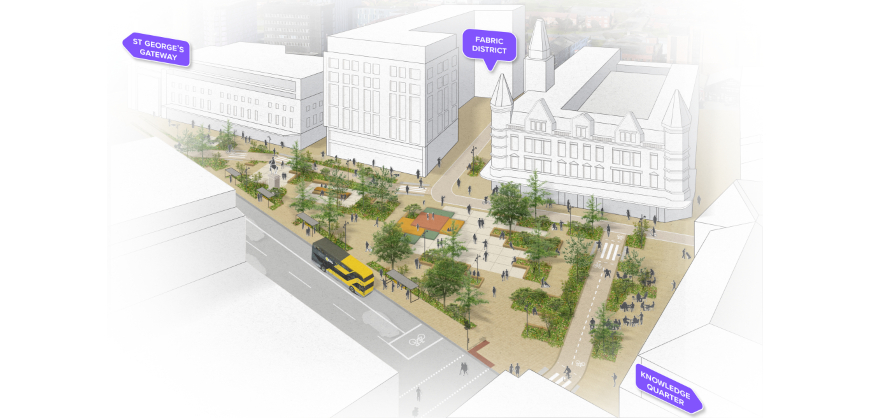
A radical makeover of a major Liverpool corridor is set to be given the green light, backed by a landmark multi-million-pound investment
Liverpool City Council has approved a £3.4 million injection – its biggest Section 106 contribution of the century – to help fund a transformational scheme in the heart of the city’s emerging Fabric District, between the Knowledge Quarter and Lime Street.
The historic sum could soon be doubled by the Liverpool City Region Combined Authority (LCRCA), pending approval from the council’s cabinet.
A report to the cabinet, tomorrow Tuesday (15 July), is seeking to confirm plans for a redesigned Monument Place, introducing dedicated bus-priority lanes and upgraded traffic signals on London Road – boosting service reliability on routes.
And thanks to the Section 106 funding, made up of monies collected from developments in the area and the match-funded LCRCA contribution, Monument Place will also be transformed into a high-quality district square with new paving, landscaping, rain gardens, seating and an event space. Enhanced walking and cycling connections into Liverpool’s wider active-travel network will also be included.
The funding and cabinet report comes as a public consultation on the scheme has been completed. Following the consultation, detailed designs will now be developed in collaboration with stakeholders.
The ambitious project combines the Metro network improvements with the Monument Place public realm works, in a partnership between the council and LCRCA.
Concept designs, jointly developed by Mott MacDonald and LDA Design in collaboration with the Fabric District CIC, have now reached RIBA Stage 2.
Once delivered, the scheme would complement plans to upgrade the St George’s Gateway which connects to this area of the city centre.
Councillor Dan Barrington, cabinet member for transport and connectivity, says: “Monument Place and the Metro upgrades mark a major turning point for one of Liverpool’s most vital city-centre corridors.
“This project will deliver quicker, cleaner bus services alongside a beautifully reimagined public space that works for everyone – residents, visitors and businesses alike.
“This bold initiative demonstrates how combining smart transport with public realm improvements can fuel growth, cut emissions and create a city that’s easier to move around and healthier to live in.”
Simon O’Brien, walking and cycling commissioner for the Liverpool City Region, adds: “These are bold and exciting plans that will transform how people move between Liverpool city centre, the vibrant Fabric District, and surrounding areas.
“Improving walking, cycling, and bus links is about transport and much more – it’s about unlocking the full potential of this part of the city region, making it healthier, more connected, and more accessible for everyone.”
Related posts:
 Lime Street remains closed as Futurist work continues
 Community clean-up to brighten Ropewalks district
 Council to introduce guidelines for filming in Liverpool
 Liverpool City Council tackles homelessness with new forum
 Free sports activities at Liverpool’s mini Commonwealth Games
 Festival Gardens to close for site investigations to inform area’s development


