When temporary permitted development rights were first introduced in 2013 – the rule allowing commercial office space to be converted into residential accommodation without the need for planning permission – it was hoped it would encourage a surge in housing stock throughout the city. Last year the government announced that the measures will now be made permanent, allowing underused buildings to offer new homes for first-time buyers and families long into the future.
Your Move looks at the impact these measures are having on Liverpool’s residential landscape.
While the measures were first announced back in 2013, it’s thought that Liverpool is only just starting to see the benefits of the now permanent office-to-resi rules. Originally set to expire in May 2016, the timescale in which to design and finance a scheme, even without full planning permission, meant there was a level of uncertainty for developers and residential agents in the city.
“There is certainly an increased interest in [office to residential developments],” says Debra Beach, branch manager at Keppie Massie Residential.
“In the next three to six months we anticipate we will see some activity in this area judging by the enquiries we have been fielding over the last six months or so.”
Research from Countrywide found that in the last quarter of 2013 and 2014 a total of 30 schemes, an equivalent of 12% of the residential units in the city centre development pipeline, were offices with permission to be converted into residential accommodation. Compare that to the almost 4,000 conversions which were given the go-ahead nationwide, Liverpool was producing limited examples of the new measures in action.
Contrary to what Liverpool City Council believed – it applied for swatches of the city centre to be excluded from the rules, only to be turned down – the measures haven’t resulted in swarms of commercial property being converted into residential accommodation. However, with the measures now permanent, conversions are beginning to hit their stride.
Many of the developments now taking shape are within Liverpool’s commercial district and city centre. An obvious location given the prominence of purpose-built commercial office space but also to target “first-time buyers who are more attracted to this type of stock” suggests Alan Bevan, managing director of City Residential.
And while he says the measures are and will continue to affect the city’s traditional commercial district, he believes it is doing so in a “very beneficial way”.
“Converting these buildings will attract residents into the city who will also make it easier for future employers to consider Liverpool as a suitable office destination due to the increased pool of talent,” he adds.

L to R: A ‘micro-apartments’ scheme is planned for 2 Moorfields; Victoria House is to be turned into 63 homes
Directly opposite James Street station, Victoria House is set to be converted in to 63 studio and one-bedroom apartments. With a train station on its doorstep and Liverpool ONE and Albert Dock a stone’s throw away, these contemporary apartments are marketed as ‘the perfect residential hotspot for young professionals looking for an urban living experience’.
The seven-storey office block, scheduled for a February 2017 completion, is one of a number of office-to-residential developments happening in the city aimed at the rise of young professionals.
A report released by Centre for Cities in 2015 found that the number of 22 to 29-year-olds living in Liverpool city centre nearly quadrupled between 2001 and 2011.
Citing the city’s rise in jobs for young professionals, the report suggests these people are willing to pay a premium to be able to walk to work, be close to shops, bars and restaurants and be surrounded by other young, professional, single people.
Liverpool’s student population is booming and there are more job opportunities than ever for graduates, along with an increasing trend for city centres to be places where people shop, work and live. Many believe it could lead to pockets of new communities in the city, particularly in Liverpool’s city central and commercial districts.
“The business district already has a thriving residential population with The Unity Building and St Paul’s Square particularly sought after, so a further fusing of the commercial and residential areas is inevitable,” says Debra.
“The most successful commercial districts are those that offer a good balance of live, work and play and are not too ‘sterile’,” adds Alan.
“Old Hall Street is an example of this which is growing its reputation to both live and work as the different uses complement each other.”
“The business district already has a thriving residential population, so a further fusing of the commercial and residential areas is inevitable.”
In the heart of the commercial district, a conversion which has been in the pipeline since 2014 is 2 Moorfields. The 1980s office building, which remains empty except for the ground floor, has had plans approved to convert the building into 135 fully furnished compact ‘micro-apartments’.
Micro-apartments are an increasing trend in cities such as New York, where they are being developed in an attempt to create more affordable living space for young workers. This trend appears to be gaining traction in many big cities as one answer to increasing housing density and utilising space, and it could be an interesting model for Liverpool to exploit now permitted development rights are here to stay.
For singles or couples who prioritise access to vibrant city life, micro-apartments like those being created at 2 Moorfields are emerging as a likely compromise between centrality, convenience and space.
While office-to-resi developments aren’t exclusive to the city centre and the business district in Liverpool, the schemes in those areas do appear to be the most sought after.
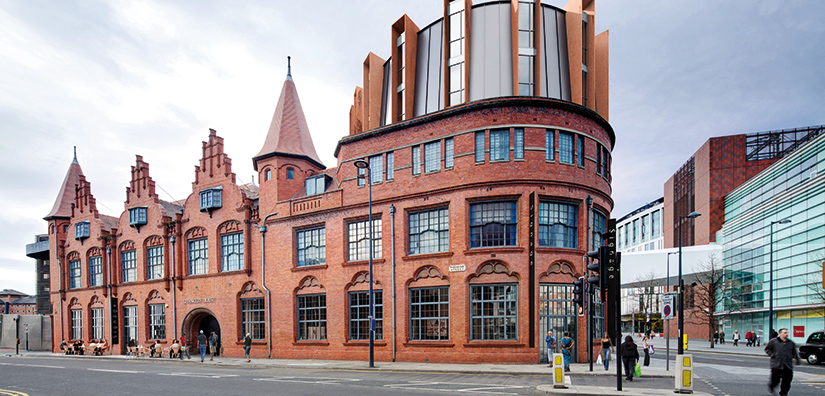
This month City Residential has launched Chancery House; a luxury conversion on the edge of Liverpool ONE which will include four penthouses and 33 one, two and three-bedroom apartments.
The Grade II-listed building, built for the Gordon Smith Institute of Seamen and later used as offices, has been unoccupied for a number of years and is another example of using the new measures to redevelop an impressive Liverpool landmark.
Although the majority of the planned office to residential conversions are yet to be completed, the pipeline continues to grow as the city gets to grips with the new measures and takes advantage of the sites ripe for residential redevelopment.
Related posts:
 Liverpool’s future: How can homes, leisure and workspace thrive alongside each other?
 Location, location, location: ‘On location’ filming in Liverpool homes
 Where to buy: A guide to Liverpool living
 Liverpool’s city centre sanctuary
 Water Street office building could meet ‘growing demand for central apartments’
 Buying a home: 2017 guide to where to live in Liverpool