

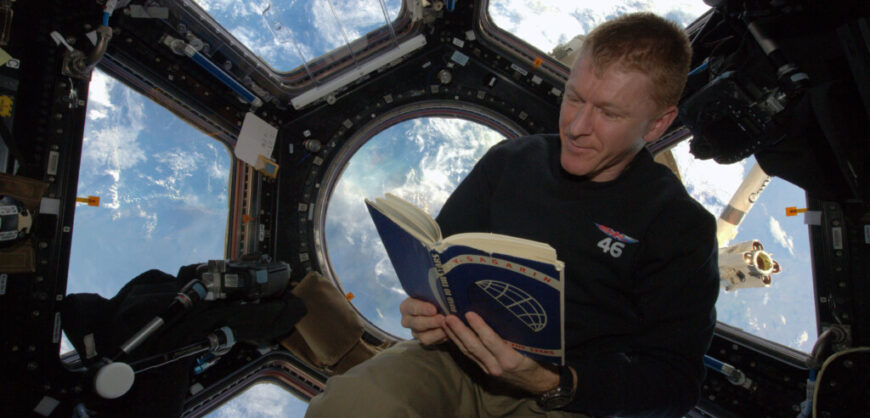
Tim Peake interview
Tim Peake is a former Apache pilot, flight instructor, test pilot and current European Space Agency astronaut.
In 2015, he became the first British astronaut to visit the International Space Station and conduct a spacewalk while orbiting Earth.
Ahead of his first UK tour touching down at Liverpool’s Philharmonic Hall later this year, we caught up with Tim to discuss his incredible journey.
You’ve journeyed into space – how has it been travelling the country with your tour?
It’s been brilliant actually! We started in October 2021, so for many people it was their first time getting out and about since lockdown, and then we did more dates in March 2022. We were pretty much sold out everywhere – which was fantastic.
I’ve done lots of speaking since joining the European Space Agency (ESA), in schools and colleges and in corporate environments, but this was my first time doing something like this and it’s quite a different experience. This is a ‘show’, being on stage for 90 minutes and that means a lot of material… And it was packed with stuff. I had to get into a different mindset to give the audience a truly immersive experience of what it’s like to be in space.
I was very conscious that people had taken the time and effort to come and see me for an evening. For some, it might have been a special birthday or Christmas gift. That was very humbling and an honour, so I wanted to give the audience a show to remember.
Can you tell us a little bit about My Journey to Space and what audiences can expect?
My Journey To Space embellishes on the stories in my book, Limitless. It takes you through how I got to be where I am, doing what I do, and what it takes to become an astronaut. I’ve enjoyed an incredible journey – from military test flying and combat mission to living in caves and training for days underwater.
The show aims to answer all your questions about living and working in space. There’s a very beautiful section which takes the audience on an orbit around Earth, looking down on the planet and then a high-adrenaline insight into spacewalking.
It’s the closest we can get to actually taking people into space. There are a lot of audio-visual elements to it, and the feedback so far has been brilliant. People say they learn a lot from coming along – whether they were already knowledgeable about space and my story or not, they’ve gotten new insights. Some of the best responses have been from the people who came along to accompany a friend or partner, and they’ve had a fantastic time.
You don’t have to be into space to enjoy it, you don’t need any prior knowledge or anything, it’s just a great experience. It’s uplifting, motivational, inspiring and funny. From eight-year-olds to 80-year-olds, it’s very much accessible for all age groups.

Final suit check before space walk / CREDIT_ ESA-NASA
How did your journey to space begin?
I did quite a bit before becoming an astronaut – had an 18-year military flying career, spent time in the US, in Bosnia and Afghanistan, and as a test pilot pushing aircrafts to their very limits. It was an interesting journey really and, to be honest, I sometimes felt like a fraud alongside some of my ESA colleagues… They were those kids at four or five years old, saying ‘I want to be an astronaut’. I wasn’t that child. I wanted to be a pilot, my passion was always flying – and that’s what I did.
Growing up in the ’80s, I didn’t – couldn’t – think that coming from the UK there was an opportunity to become an astronaut. No one here was thinking of that in the ’80s, it was something that seemed to only be available to Russians and Americans.
I left school with three below-average A Levels, and joined the Army where I was lucky enough to be able to learn how to fly. And I was relentless in my career, always learning, trying to improve myself. I never stopped studying. As a test pilot, I realised I needed to raise my game academically and eventually got a degree in my early 30s.
For me, hard work, endurance and perseverance were key – and because of that, I could grasp an opportunity when it arose.
The European Space Agency chose you from more than 8,000 applicants across Europe. How did that feel?
Getting to the point of being invited to join the European Space Agency was an absolute rollercoaster of emotions. Just the very fact that we, as UK residents, could potentially join the ESA, the fact that we could even apply to the programme was something of great excitement to people like me.
At the time, I was working as a test pilot and there was a huge buzz among my friends and colleagues. Thousands of people applied the very first time applications opened – and out of 8,413, only around 800 or 900 were accepted through the first round – so I was very lucky to even make that cut.
For me, I knew that was going to be the toughest round. I knew I came from a less academic background… Yes, I had my degree by then, but some of the people around me had PhDs and were working at CERN (European Council for Nuclear Research).
When we got down to the final 10, with just four places available, the director general of ESA wanted to meet all of us – and he then decided he was going to actually select six people. Even then, I didn’t quite believe I’d make the final cut as at that time, the UK wasn’t paying into the human spaceflight programme, so why would they choose a UK candidate?
The announcement was planned for a Wednesday, and I got a phone call on the Monday evening – by which time, I’d assumed it was a ‘Thanks but no thanks’ call. Instead, they were asking me to get to Paris, ready for the announcement.
I wanted to keep it a secret to myself, but my wife caught on to the call as I couldn’t hide my excitement. I was allowed to tell my immediate family. It was a big shift for us as we were preparing to leave the Army; we were all set to move to Yeovil for a civilian job as a test pilot – and all of a sudden, the plan changed and we were moving to Cologne.
Sometimes you just have to grab an opportunity when you have the chance.
How did you prepare for the mission?
The full training programme took place over four or five years – and even a year after being selected, going into space wasn’t a guarantee as the UK still wasn’t part of ESA’s human spaceflight programme. There was lots of politics going on behind the scenes. Once I was actually assigned to the mission and it was announced that I would be going to the International Space Station for six months as a British astronaut, the media attention began to ramp up. There was so much excitement from all quarters.
The two years leading up to launch were a blur of activity. There was so much training, so much to learn: how to fly a spacecraft, do a spacewalk, dock cargo vehicles, deal with emergencies, maintain the space station and conduct all the science experiments. Then there’s medical training too and in any spare time, preparing the educational outreach projects.
When it came to the final preparations, we were in Kazakhstan and they gave us 10 days – in quarantine – with not too much activity scheduled. I was allowed a socially distanced walk with my family, which was a very special moment to be able to say goodbye. But overall, it was nice at that point to just enjoy the experience in a kind of peace as it had been such a busy time. It was nice to take a breath, pause and have time to reflect.

Tim Peake space walk / CREDIT_-ESA-NASA
So what is it like to actually launch into space?
There’s one word: phenomenal. You do all the training, going into a centrifuge to experience the G forces, all of that. But nothing can prepare you for the blast of a rocket propelling you to 25-times the speed of sound.
During the first stage, you’re very aware of the power because of all the noise and vibration and G force. It’s full-on. But as you reach space, the rocket levels out and becomes horizontal. There’s no drag, nothing slowing you down, and yet this rocket is still creating four Gs of acceleration… The feeling of speed is overwhelming. That is the point when you really know you are entering another realm.
It’s a very violent experience, in terms of energy. Then, when the engine cuts out, weightlessness kicks in, and you’re looking down on a beautiful planet, and it is eerily quiet. It’s very otherworldly. It takes a while to be able to process just where you are and what you’re doing. It was an incredibly special experience. Luckily, you then get six months to really contemplate it…
What were the highlights of your six months in space?
The actual spacewalk was definitely a big one. Leaving the sanctuary of the space station is enormous – it’s the most exhilarating experience you can imagine. But you have to be on your A-game, the feeling of danger is palpable. I was extremely proud to be the first person to wear a Union Flag on a spacewalk.
And running the London Marathon in space was a big moment of connection back to Earth too, as you’re very isolated out there. NASA streamed the BBC’s marathon broadcast to the ISS, so I was watching the marathon on my laptop as I was running it. Being able to see all the runners, the crowds, and the landmarks, really spurred me on.
Then there were the small moments, like brushing your teeth before bed. The hygiene station was next to our large Cupola window, so you’d be doing this very normal daily activity while looking down on the world passing by. There was always something new and different to see – and Earth is a beautiful planet from space. Having that moment of peace each night to reflect on what you’re doing and where you are was always special, as the space station is usually such a busy place.
What do you think is the future of space travel?
The majority of the general public probably do not realise just how exciting the next few years are going to be for space exploration! We are so very close now to putting human beings on the Moon again. I was born in 1972, which is the year the last human walked on the Moon… Within the next five years, we will see humans on the lunar surface once again. And we’re not that far from the first mission to Mars either. I think we will be on Mars in 10 to 20 years.
Lunar exploration is focused on the Artemis programme. There’s an uncrewed spacecraft launching this summer, and then the first crewed mission should be next year. It will be similar to the Apollo 8 mission, spending 10 days or so in orbit around the Moon, to prepare for future missions. I think we’ll be looking at 2025 or 2026 for the first crewed surface landing on the Moon since 1972.
There is also a big focus on Mars – that is the destination to achieve in the medium term. Then I think there will be a big pause in further human solar system exploration. Instead, I think the focus will be on maximising the space environment for the benefit of everyone on Earth, in terms of potential new sources of energy, communications, scientific research and cutting-edge technology.
There’s nothing stopping us from exploring Mars today – no insurmountable technological hurdles. But beyond Mars, there remain big challenges for humans. Venus and Mercury are reasonably close, but they are very inhospitable planets.
Some of the moons of Jupiter and Saturn are really interesting, as they have liquid water oceans under frozen surfaces. But the complexity of actually getting there is 10-times more difficult than Mars. I think it will take another huge leap in technology before we can consider sending humans to the furthest parts of our Solar System.
But it will happen, one day!
Tim Peake: My Journey To Space, Tuesday 6 September 2022 at the Liverpool Philharmonic Hall
Main Image © NASA
Related posts:
 Interview: Actor, writer and comedian Simon Day talks to Your Move
 The Interview: Author and television presenter Simon Reeve on his new show and adventures
 Tommy Tiernan interview: Comedian talks ‘Derry Girls’ and LFC ahead of Philharmonic show
 British Music Experience launch exhibits confirmed
 Dame Jacqueline Wilson: Interview with children’s author ahead of Liverpool talk
 Andrew Marr interview: TV presenter debuts his art in Liverpool


